


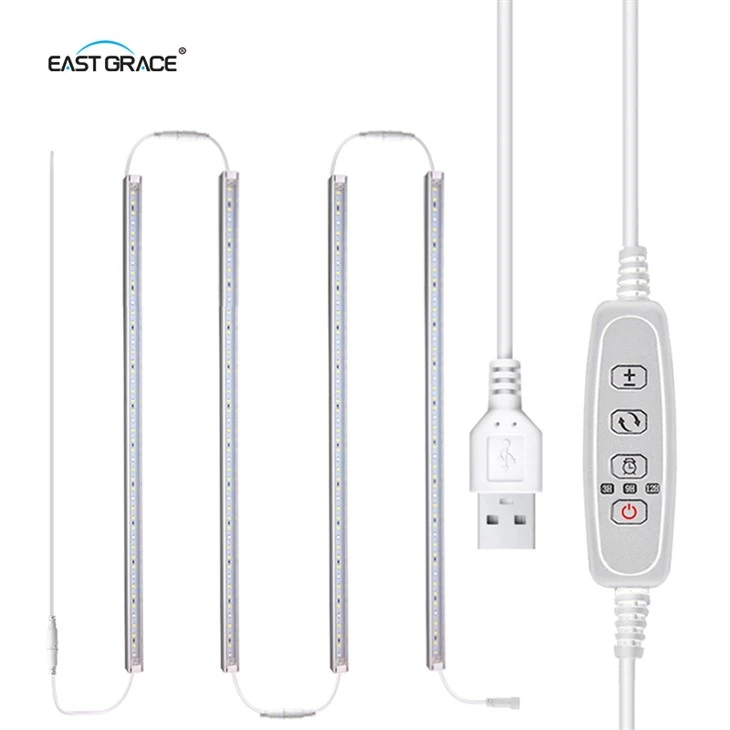


Description
Send Inquiry
DC Strip LED Grow Light
A grow bar is easy to buy and hard to buy well. This one is specified like a fixture: a 14 mm aluminium channel, Sanan 2835 diodes, a potted and sealed IP65 body, and a waterproof connector atbothends so a whole bench can run from one 24 V port. Two lengths cover the usual tier widths - 500 mm at 10 W and 1000 mm at 20 W - at roughly 2.0 µmol/J, with a spectrum you can specify down to the wavelength ratio.
01 Who this page is written for
| This is a sourcing document, not a consumer listing. The questions that decide a purchase order for a strip fixture are different from the ones that decide a single-unit retail sale: what the connector is rated for, how many bars one adapter can carry, whether the spectrum can be locked to a crop recipe, how the carton survives a pallet drop, and what happens eighteen months later when a customer reports one dead bar out of four hundred. The sections below answer those, in the order a technical buyer usually asks them. If you only need the numbers, the specification table is in section 02 and the customization matrix is in section 06. |
|
| Buyer snapshot | Detail |
| Typical order profile | Samples 2–10 pcs for bench trials; repeat orders 300–5,000 pcs; container loads for distributors |
| Best-fit applications | Multi-tier racks, vertical farms, propagation shelves, greenhouse interlighting, tissue-culture rooms, retail live-plant displays |
| What is fixed | Aluminium + PC construction, 24 V constant-voltage input, IP65 sealing, 120° beam, flicker-free driver pairing |
| What is open | Length, spectrum ratio, connector type, cable length, printing, retail packaging, controller bundle |
| Lead time | Stock specification 7–15 days; custom spectrum or printing 20–28 days after artwork approval |
02 Specifications: EG-SDCGL-50 and EG-SDCGL-100
| Both models share one platform - same channel, same diode, same connector, same optics. The only variables are length, diode count and wattage, which is what makes mixed pallets practical: a customer can stock 500 mm bars for edge filling and 1000 mm bars for main rows without carrying two sets of spares. | ||
| Parameter | EG-SDCGL-50 | EG-SDCGL-100 |
| Product size (mm) | L500 × W14 × H7 | L1000 × W14 × H7 |
| Wattage (W) | 10 | 20 |
| LED quantity | 72 pcs | 144 pcs |
| LED light source | 450 nm; 660 nm; (385 nm; 730 nm optional) | |
| LED brand / type | Sanan 2835 | |
| Materials | PC + aluminium | |
| PPFD @ 0.3 m | ~60 µmol/s/m² | ~80 µmol/s/m² |
| PPE | ~2.0 µmol/J | |
| Power factor | > 0.90 | |
| Flicker | Flicker free | |
| Input voltage | DC 24 V (external AC-DC adapter) | |
| Dimming | Dimmable (external controller or dimmable adapter) | |
| Beam angle | 120° | |
| IP rating | IP65 | |
| CRI | Ra > 80 | |
| Operating temperature | −15 °C to 40 °C | |
| Warranty | 3 years | |
| PPFD values are measured on a reference unit at 0.3 m in open air and are intended for model-to-model comparison. Canopy readings depend on mounting height, row spacing and room reflectance - see the mounting guidance, or ask us for a layout calculation for your rack. | ||
03 Three design choices worth checking before you compare prices
| 3.1 The spectrum is a recipe, not a colour Blue at 450 nm and deep red at 660 nm sit close to the absorption peaks of chlorophyll a and b, which is why almost every horticultural LED recipe is built around those two wavelengths. But "red + blue" describes a family, not a product: a 1:1 ratio, a 3:1 ratio and a 5:1 ratio behave very differently on the same bench - the first keeps internodes short, the last pushes leaf area and stem extension. Getting the ratio right for the crop is the difference between a usable fixture and one that makes seedlings stretch. Two optional wavelengths extend the recipe. Far-red at 730 nm works through phytochrome rather than photosynthesis: a small dose at the end of the photoperiod can accelerate the shade-avoidance response and expand leaf area, and it is increasingly used in leafy-green and transplant programmes. UV-A at 385 nm is added when a buyer wants a secondary-metabolite or colour-expression effect, typically at a low single-digit percentage of total output. Both are optional because both cost money and neither is appropriate for every crop - we would rather quote them as options than build them into a default. Calibration happens in our own spectroscopy laboratory, where a reference sphere is used to verify peak position, full width at half maximum and the ratio between channels before a batch is released. That matters commercially: if you reorder in fourteen months, the batch should match the sample on your bench, not merely match the datasheet. Spectral power distribution of the LED grow light strip showing 385 nm UV, 450 nm blue, 660 nm deep red and 730 nm far-red peaks Extended recipe: 385 + 450 + 660 + 730 nm. Peak positions and relative intensities are set per order; the standard build omits UV and far-red. |
| 3.2 Double wiring means one power port per row Each bar carries a male connector on one end and a female on the other, both sealed to IP65, so bars can be joined end to end and fed from a single adapter at the head of the row. On a five-tier rack with three bars per tier, that is one cable drop per tier instead of three - the difference between a tidy installation and a junction box on every shelf. The rule we give buyers is simple: add up the connected wattage, then size the 24 V adapter with 15–25 % headroom. Six 20 W bars is 120 W, so a 150 W adapter is the sensible match, not a 120 W unit running at its limit in a warm room. Long runs also lose voltage at the far end, which shows up as a dimmer last bar rather than an outright failure; beyond roughly 10–12 m of total run we recommend splitting into two feeds rather than chasing the loss with a bigger adapter. |
| 3.3 Keep mains voltage out of the grow room Because the bar runs on 24 V DC, mains voltage stops at the adapter. In a wet room that is a safety argument, but it is also a service argument: a failed driver means replacing one adapter at the end of the row, not opening a sealed luminaire above a canopy and disturbing a crop that is mid-cycle. It also simplifies compliance, because the luminaire itself is a low-voltage device and the certification burden concentrates on the adapter, which can be specified to the destination market. |
| Adapter option | Capacity | Typical use | Notes |
| Standard 24 V | 24 W / 36 W / 60 W | 1–3 bars per port, hobby-to-semi-pro racks | IP20 for dry rooms; IP67 for washdown areas |
| High-capacity 24 V | 100 W / 150 W / 200 W | Full tier runs, 5–10 bars | Fan-free, aluminium housing, screw terminals |
| Dimmable / controller | 60 W / 100 W | Multi-stage recipes, photo-period control | 10-step dimming, 3 h / 9 h / 12 h timer versions |
| Bare wire (no adapter) | - | Integration into an existing 24 V bus | Buyer supplies DC source and enclosure |
04 Spectrum options you can order
| The recipes below cover most enquiries. They are starting points, not a catalogue limit - if a customer sends spectral data from a trial, the lab can match peak positions and channel ratios rather than asking the grower to adapt to a stock SKU. | ||||
| Code | Ratio | Wavelengths | Best stage | Buyer note |
| RB-11 | 1 : 1 red / blue | 450 + 660 nm | Propagation, tight seedling control | Compact habit; useful where light must be kept low |
| RB-31 | 3:01 | 450 + 660 nm | Leafy greens, lettuce, herbs | Balanced default for shelf production |
| RB-51 | 5:01 | 450 + 660 nm | Vegetative bulk, transplant finishing | Larger leaf area, faster canopy closure |
| RB-FR | 3 : 1 + far-red | 450 + 660 + 730 nm | Leaf expansion, flowering triggers | End-of-day dosing discussed per crop |
| RB-UV | 3 : 1 + UV-A | 385 + 450 + 660 nm | Colour expression, secondary metabolites | Low percentage only; verify with crop trial |
| FS-Hybrid | White + deep red | White + 660 nm | Inspection-friendly rooms, retail display | Easier visual crop assessment for staff and cameras |
| Ratio tolerances, bin selection and per-batch spectral report are agreed at order stage. Minimum quantity for a non-standard recipe is typically one production batch. | ||||
05 Who buys it, and what we prepare for each buyer
| Four buyer types account for nearly all of our strip-bar volume, and each one cares about a different part of the file. Being explicit about that shortens the quotation cycle considerably. | ||
| Buyer type | First question | What we send |
| Wholesaler / distributor | Price break at 1,000 and 5,000 pcs, carton size, mixed pallet? | Landed-cost sheet, carton and pallet dimensions, spare-part ratio, neutral or branded box |
| Brand owner (private label) | Can the channel carry my logo, and is the spectrum mine? | Laser-marking artwork template, packaging dielines, spectrum lock and batch traceability |
| Project buyer (vertical farm, container farm) | Will it deliver the PPFD my crop plan needs at my tier height? | Layout calculation, PPFD grid at canopy plane, adapter and circuit schedule, commissioning sheet |
| Retail / e-commerce seller | Does it sell as a kit, and does it survive parcel handling? | Retail-ready kit configurator (bar + adapter + clips + timer), drop-tested mailer, listing images |
06 OEM and ODM: what can be changed
| Length and pitch 300, 500, 1000 and 1500 mm channels; diode pitch adjusted for target watt-per-metre. Spectrum Any ratio built from 385 / 450 / 660 / 730 nm, or a white-reinforced hybrid recipe. Connector and cable Sealed DC barrel, screw-terminal or board-to-board; cable length from 150 mm to 3 m. Connector and cable Sealed DC barrel, screw-terminal or board-to-board; cable length from 150 mm to 3 m. Packaging Neutral carton, printed retail box, or kit box with adapter, clips, screws and manual. Control bundle Adapters from 24 W to 200 W, with or without dimming and timer modules. Samples for a custom recipe are typically 5–10 working days; stock samples leave in about 3 days. Tooling is not normally required for printing or packaging changes, which keeps the entry cost low for a first private-label run. |
07 Built, tested and documented
| Buyers audit process, not promises, so here is the sequence every batch goes through - from diode reel to sealed carton. Incoming diode check Wavelength and forward-voltage binning verified against the approved sample; reels outside tolerance are rejected before SMT. SMT and reflow Lead-free reflow on aluminium-backed PCB, AOI inspection after reflow, manual rework station for any flagged joint. Assembly and sealing PC diffuser seated into the extruded channel, end caps potted, connector gaskets fitted; sealed units are visually inspected under magnification. Aging 100 % of units run at rated voltage before packing; failures are removed at this stage rather than at the customer's site. Photometric verification Sampling from each batch measured in the integrating sphere for flux, peak wavelength and colour consistency against the golden sample. Sealing and packing test IP65 sample checks with spray testing, plus carton drop testing on the retail configuration before a new packaging run is released. Documents available with a quotation: CE (LVD / EMC) and RoHS declarations for the relevant SKU, photometric test report, IP65 test report, REACH statement, and material declarations on request. Tell us the destination market and we will confirm which certificate set applies to the exact configuration - adapter choice changes the answer, which is why we do not publish one generic certificate badge for the whole range. |
08 An honest comparison with the alternatives
| Nobody buys a strip bar in isolation; it is always a choice against a tube, a tape or a panel. Here is where each format wins, including the cases where our own product is not the right answer. | |||
| Format | Strengths | Weaknesses | Pick it when |
| This DC strip bar | 7 mm profile, rigid aluminium heat path, sealed connectors, one port per row, serviceable adapter | Needs an external adapter; not a high-bay fixture | Tight tier gaps, long runs, wet rooms, OEM programmes |
| T5 / T8 LED tube | Familiar, cheap to replace, wide availability | Glass or plastic tube with end caps; socket contacts corrode in humidity; light spreads into aisles | Retrofit of an existing fluorescent rack, low budget |
| Flexible SMD tape | Lowest cost per metre, cuttable, adhesive backing | No real heat sink, adhesive fails in warm humid rooms, IP rating often overstated, no mechanical protection | Decorative or short-term trial runs |
| Panel / flood fixture | High output from one point, good for single-layer rooms | Consumes vertical space, edge falloff on wide benches, wasted photons in aisles | One or two benches, taller ceilings, flowering rooms |
09 Packing, shipping and commercial terms
| Item | Standard | Notes |
| Inner packing | Anti-static sleeve + moulded end protection | Kit versions add a compartmented tray for adapter and clips |
| Outer carton | Double-wall corrugated, 50–100 pcs depending on length | Carton mark printed to buyer's specification |
| Pallet | Export pallet, stretch-wrapped, mixed SKUs allowed | Mixed pallets are how most distributors order |
| Terms | EXW / FOB / CIF / DDP | DDP available for EU, UK and North America |
| Shipping | Air for samples and 100–500 pcs; sea for container volumes | Express courier for single samples, 3–6 days door to door |
| Payment | 30 % deposit / 70 % before shipment; T/T, trade assurance | Terms for repeat customers discussed individually |
10 Warranty and what actually happens after a failure
| Three years on the bar, with the adapter covered under its own term. In practice the failure mode on a low-voltage strip is almost always the adapter or a connector, not the diodes, so the service policy is built around that: for orders above a threshold quantity we include a small percentage of free spare adapters, and for isolated failures we ship a replacement part rather than asking for the unit back. Returning a 10 W bar across an ocean costs more than the bar is worth, and it delays the grower's fix by weeks. Dead on arrival: replaced in the next shipment, no return required for units under the value threshold. In-warranty failure: remote diagnosis first (adapter voltage, connector seating, total connected load), then part replacement. Out-of-warranty: spare bars and adapters kept available for at least five years after a model is discontinued. |
11 Questions buyers ask before the first order
| Does the quoted price include the power adapter? No - the bar and the adapter are quoted separately. Some buyers already run a 24 V bus and want bare bars; others need a complete kit with adapter, clips and screws. Tell us which and the quotation will reflect it. Kit pricing is usually more attractive than buying the parts separately. |
| How many bars can I chain on one adapter? Size the adapter at the sum of connected wattage plus 15–25 % headroom. A 100 W adapter comfortably carries four 20 W bars or eight 10 W bars. Keep total run length under roughly 10–12 m, and split into a second feed beyond that so the last bar in the line does not read visibly dimmer. |
| Can you build a spectrum for one specific crop? Yes. Send the target ratio, a reference spectrum, or the results of a trial you have already run, and the lab will match peak positions and channel proportions. Non-standard recipes normally require one production batch as a minimum, with a spectral report supplied against the approved sample. |
| What is the minimum order for a custom length or logo? Logo marking has a low entry point and no tooling cost because it is laser-applied. Custom channel lengths need a new extrusion die, so they are quoted per project - often worthwhile at container volumes, rarely at sample volumes. Standard lengths are 300, 500, 1000 and 1500 mm. |
| Is it dimmable out of the box? The bar itself is dimmable; dimming happens at the driver. Order the dimmable adapter or controller version and you get 10-step brightness plus optional 3 h / 9 h / 12 h timers. With a third-party 0–10 V or PWM driver, the bar dims as a load without modification. |
| Can you calculate the layout for my rack? Yes. Send tier length, tier depth, clearance above canopy, number of tiers and the crop, and you will receive a recommended bar count, row spacing, mounting height, PPFD estimate at canopy plane and an adapter schedule. This is the fastest way to avoid ordering too few bars and running them at maximum output. |
| What is the lead time for 1,000 pcs? Stock specification is typically 7–15 days depending on the current schedule. Custom spectrum or printed packaging runs 20–28 days from artwork approval, plus transit. If you have a fixed installation date, say so at enquiry stage - production slots can be reserved. |
Send your rack drawing - get a lighting layout back
| Tell us tier dimensions, crop and target photoperiod. We will return a bar count, mounting height, PPFD estimate and a quotation with adapter options, so the comparison against other suppliers is like for like. |
| EG-SDCGL-50 / EG-SDCGL-100 · DC strip LED grow light · Specifications subject to improvement without notice. Photometric values are reference measurements; confirm performance for your installation with a layout calculation. |
Hot Tags: 10w 20w dc strip led grow light, China 10w 20w dc strip led grow light manufacturers, suppliers, factory


