


East Graces has been involved in LED development since 2008, obtain the IEC 62471 of LED product safety in 2016. We are a professional producer at led modules, power supplies and different kinds of component for electronic and lights. Concentrated in LED core area expansion, Plant Light to improve agricultural industry efficiently furthermore.
Why Choose Us
Our Factory
East Graces has been involved in LED development since 2008, obtain the IEC 62471 of LED product safety in 2016. We are a professional producer at led modules, power supplies and different kinds of component for electronic and lights.
Our Product
We provide vary of lights, such as tubes, tri-proof lights, mosquito-killer lamp, and Ambient Light etc. Tubes and grow light are especially popular in the market.
Professional Team
East Graces continuing to provide excellency products and earn multiple innovation and patents, thanks to the specialized development team with advanced technology and high-performance automatic equipment endeavor.
Our Service
Providing technical consultant service, design and customize for free. Pleasing to visit the production procedure, inspection facilities and quality management system. Follow up producing schedule, quality monitoring and offer goods examine.

Interlighting Plant LED Grow Light
EG-IP12DGL-50C has two sides LEDS with 360°lighting emit, which can ensure the maximum illumination area and light up all surrounding plants. External driver for easy maintenance and heat dissipation. Vertical mounting with daisy-chain solution to make it ideal for grow tower application.

Toplighting LED Grow Light Fixture
Top lighting LED Grow Light Fixture for indoor plants, vegetables, and flowers. It performs well in all growth stages.

T8 Integrated LED Tube Grow Light2
EG-WI8PATG-150 full spectrum led grow light tube provides indoor plants with full-spectrum sunlight replacement at 385nm-730nm. It provides the most optimal growth light wave based on the ratio of the absorption of the plants. It is suitable for plant shelves, hydroponics growing rooms, and greenhouses.

Foldable LED Grow Light Bar Module
This powerful lamp offers a full spectrum of light in a 720 watt, L1100*W1060*H45 mm design, giving you efficient light with 50000 hours lifespan. In addition, the EG-FBMGL-720C-IN produces 1350 Umol/s PPF output and 2.4 Umol/J PAR luminous efficacy.

DC Strip LED Grow Light housing is made of high-quality aluminum with good heat dissipation, which is perfect for shelves, germination, seed starting, fruiting, flowering, hydroponics, and potted plants.

UFO LED High Bay Grow Light Fixture
EG-UHBGL-250 LED grow light has excellent lumen output, long-lasting stability, and brilliant vision. UFO LED high bay light fixture equipped with a 0-10V dimmable driver. An aluminum die-cast heat sink provides optimal heat dissipation and long-span life.

The EG-CTGL-20 Full Spectrum Grow Light is design for indoor garden plants specifically. This sunlight-grown light can promote the photosynthesis of plants. Widely apply to the culture solution, horticulture, and potted plant, especially when the plant needs extra light when raining, snowing, dark indoors, etc.

EG-RUBLGC-30 full spectrum led plant light bulb provides the most efficient wavelength of light for maximum absorption by plants, lower heat, no radiation, and mercury. EG-RUBLGC-30 led grow light has a smaller and lighter design. It has a variety of light required for growing seedlings, dragon fruit, strawberries, succulents, and other plants.

The EG-RUBLGB-50 is a high-performance lighting system designed to meet every stage of plant growth. The EG one will ensure healthy seeds and leaves, leading great start to the future. It will also promote the flowering and fruiting rates while guaranteeing the quality and giving you a prosperous harvest, ideal for flowering and non-flowering plant species.
What Is T8 Integrated Led Tube Grow Light
A LED light pipe is an engineered, precision molded optical component or optical fiber that transmits light from the light source, i.e. LED on a circuit board, to the outside of the housing or panel. They are typically produced from Polycarbonate or other optical grade material. To ensure high performance and durability, only uses fresh, high-quality polycarbonate in the production of its light pipes; Light pipes can be designed to be compatible for use with any LED packaging, however typical light pipe construction is designed with surface mount LEDs.
Advantages of T8 Integrated LED Tube Grow Light
1. LED fluorescent lamps do not use mercury and do not contain lead. Traditional fluorescent lamps contain a large amount of mercury vapor. Once such lamps are broken, the mercury vapor will volatilize into the atmosphere and pollute the environment. LED fluorescent lamps can It protects the environment and is one of the recognized green light sources.
2. LED fluorescent lamps are cold light sources and do not emit a lot of heat energy like traditional lamps. It can basically convert all electrical energy into light energy without causing any waste of energy and is very economical.
3. LED fluorescent lamp is a very quiet energy-saving lamp that does not produce noise like traditional fluorescent lamps. It is very suitable for environments that require quietness, such as libraries and offices. It can also protect our eyes very well, starts very quickly, and does not flicker, which is very beneficial to our health.
4. Because the LED fluorescent lamp is a green and environmentally friendly lamp, it does not produce ultraviolet light, infrared light and other radiation, does not contain harmful substances such as mercury, and generates less heat, which can effectively avoid mosquitoes surrounding the light source. This creates a relatively clean environment indoors.
5. LED fluorescent lamps have a long service life. Their power consumption is less than one-third of traditional fluorescent lamps, but their brightness is the same as traditional fluorescent lamps. Generally speaking, the lifespan of normal use is more than 30,000 hours. It does not need to be replaced after long-term use, which virtually reduces labor costs. It is very suitable for some occasions where it is inconvenient to replace lamps. Of course, LED fluorescent tubes are very rich in color and can be produced in various lighting colors to meet the needs of different occasions.
LED provides monochromatic light with a large half-width. Since the energy gap of the semiconductor decreases with the increase of temperature, the peak wavelength it emits increases with the increase of temperature, that is, the spectrum is red-shifted, and the temperature coefficient is +2. ~3A/. LED luminance L is approximately proportional to the forward current. As the current increases, the luminous brightness also increases approximately. In addition, the luminous brightness is also related to the ambient temperature. When the ambient temperature is high, the recombination efficiency decreases and the luminous intensity decreases.
The terminal voltage of the PN junction forms a certain potential barrier. When a forward bias voltage is applied, the potential barrier decreases and the majority carriers in the P and N regions diffuse toward each other. Since the electron mobility is much greater than the hole mobility, a large number of electrons will diffuse to the P region, constituting the injection of minority carriers into the P region. These electrons recombine with holes in the valence band, and the energy obtained during the recombination is released in the form of light energy. This is the principle of PN junction luminescence.
What Is the Difference Between Normal LED Lights and LED Grow Lights

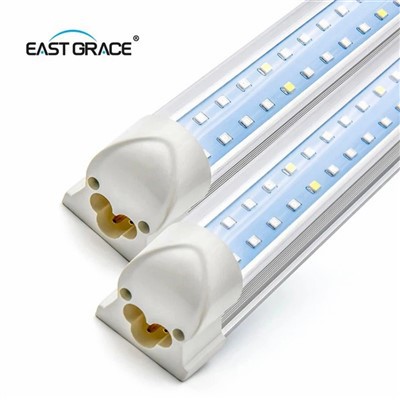


LED lights and LED grow lights both use the same technology, but their applications differ. LED lights are often used as a replacement for incandescent bulbs in homes or businesses to provide general lighting. LED grow lights, on the other hand, use specific light options that are designed to encourage the photosynthesis of plants.
The main difference between these two types of lights is the light intensity, spectrum, and color temperature. Regular LED lighting typically has lower brightness levels than what would be required for optimal plant growth. In addition, regular LEDs offer limited control over the type of light output needed for healthy plant development. Grow lights can provide more intense illumination with adjustable settings that allow you to fine-tune your desired level of light for optimum results when growing plants indoors.
Grow lights also emit different spectrums of light than traditional LEDs. The special light produced by grow lamps enables plants to absorb necessary nutrients which helps promote healthy growth and flowering cycles within an indoor environment. This creates a perfect balance for successful indoor gardening all year round without having to rely on natural sunlight alone.
Do LED lights work the same as grow lights
Standard LED bulbs typically emit more light with a broader range of colors in comparison to standard incandescent or fluorescent lights. While general-purpose LED lighting will give off white-light illumination, grow lights will produce greater amounts of red and blue spectrums which are ideal for stimulating photosynthesis in plants. Furthermore, when it comes to power efficiency, grow lights tend to consume less energy than traditional lighting solutions like fluorescent tubes or high-intensity discharge lamps usually found in commercial settings.
When choosing an appropriate LED fixture for your plants there are some important aspects you should consider such as the specific needs of your plant species, the size and shape of the area where you need coverage, and any additional features that might make installation easier or improve performance such as programmable timers or adjustable brightness levels. When looking at LED options specifically designed for growing, remember that higher wattage does not always mean better results. It's all about providing the right kind and amount of light tailored to your particular setup!
What type of LED is best for growing plants
When it comes to growing plants, LED grow lights are often the preferred option compared to normal LED lighting. This is because LED grow lights provide a more tailored spectrum of light that enables plant growth better than traditional fluorescent or incandescent bulbs. Specifically, LED grow lights give off specific amounts of blue and white light which supports healthy photosynthesis in plants. Additionally, they contain green and red visible light as well as other non-visible spectrums such as infrared (IR) and ultraviolet (UV).
LED lights, on the other hand, don't have this same level of customization when it comes to providing the right kind of light for plants. They contain one type of color temperature like cool white or warm white but lack many wavelengths necessary for healthier plant growth. Compared to natural sunlight, these limited colors can cause stunted growth or even death if used too long without proper rest periods.
In comparison to regular LEDs, using LED grow lights provides far greater energy efficiency while still giving your plants all the nutrients required for them to thrive. With careful consideration over wattage output, beam angle, and coverage area, you will be able to get the most out of your LED grow light setup with minimal power usage.
How To Choose LED Light Pipes
Look at the packaging and labels
National mandatory product LED lighting manufacturers mark the following on the packaging: rated voltage range, rated power, rated frequency. Under normal circumstances, high-quality printed products have good quality, clear writing and are not easy to fall off. Wipe with a soft damp cloth. The logo is clearly legible, including the manufacturer's trademark and related certification marks.
Look at the appearance of LED light tubes
Real LED fluorescent lamp. From a lamp perspective, the shape and size of lamps are better and more consistent, product consistency is better, and quality assurance is easier. Of course, there should be no cracks in the appearance and loose joints. LED lamps must choose the engineering plastic flame-retardant plastic PC shell. Ordinary plastic deformation and flammability, the aluminum tube must be bright, aviation aluminum.
Working temperature
When the LED fluorescent lamp is operating normally, the temperature should be low. Otherwise, the life of the LED light is very short. At the same time, when the energy-saving lamp is lit, it flashes rapidly or fluctuates very harshly, indicating that there is a quality problem with the energy-saving lamp. A few minutes after the power is turned on, there should be a temperature, which proves that the heat dissipation is good and the aluminum substrate is used for heat dissipation. There is no temperature, it is a fiberglass board, and the heat cannot be dissipated.
Check the startup performance
The startup of LED fluorescent lamps has a special feature: It lights up when powered on and does not flicker.
Weigh and compare the weights of each other
The heavier ones are better than the lighter ones. The heavier ones indicate that the materials are better used.
What Color LED Is Best for Plants
White light: This is the most commonly used type of artificial lighting in gardens and greenhouses. Most white lights are a combination of wavelengths, including red and blue waves that support photosynthesis as well as other colors necessary for plant growth. Natural sunlight also contains all of these wavelengths, making white light a good option if natural sunlight isn't available.
Red light: Red wavelengths are beneficial for increased flowering and fruiting in plants. They're incredibly effective at stimulating hormone production, thus helping enhance blooming and fruiting capacity in flowers and vegetables. This is why red lights are often found in greenhouses during the winter months when daylight hours are shorter.
Blue light: It is essential for proper leafy vegetation growth, such as grasses or herbs. Blue wavelengths stimulate chlorophyll production which helps create stronger stems, robust foliage, and denser overall plant structure. Additionally, blue lights help prevent foliar diseases like powdery mildew or other fungi by slowing down water uptake in certain species of plants.
UV-A/UV-B infrared lights: UVA/UVB infrared lights offer additional benefits to your plants' health. They support photosynthesis while also reducing bacteria buildup on leaves. This helps keep flowers healthy while increasing their longevity and avoiding diseases caused by parasites or fungal spores.
|
Light Color |
Wavelength |
Effect On Plants |
|
Blue Light Spectrum |
400-500 nm |
Stimulates chlorophyll productionPromotes vegetative growth, leaf development, stem elongation, and root growthAllows more CO2 to enter the leavesEnhances photosynthetic efficiencyOrient plant growth toward the light sourceTightly manage growth cycles |
|
Red Light Spectrum |
600-700 nm |
Triggers the transition from vegetative growth to reproductive growthStimulates flowering hormone production to start the flowering process Enhances flower and fruit developmentInfluences seed germination |
|
Green Light Spectrum |
500-600 nm |
Less effective compared to red and blue lightsHelp penetrate deeper into the plant canopyIt can reach the lower leaves of a plant to help them in photosynthesis |
|
Far-Red Light Spectrum |
700–850 nm |
Stem elongationLeaf expansion and flowering initiationInfluences seed germination Manipulate plant height and flowering timeIncrease fruit yield in short-day plants |
|
Orange Light Spectrum |
590–620 nm |
Encourage plants to photosynthesizeInfluences plant movement |
|
Yellow LightSpectrum |
570–590 nm |
Minimal photosynthetic activitySimilar to the orange light spectrum |
|
Ultraviolet (UV) Light Spectrum |
UV-A (315-400 nm) |
Regulates various physiological processes Enhance the production of secondary metabolites |
|
UV-B (280-315 nm) |
Has both positive and negative effects on plantsStimulates the production of certain secondary metabolitesInfluence plant morphology,Excessive UV-B damages DNA |
|
|
UV-C (100-280 nm) |
Not good for plants/horticultural purposesCan cause severe damage to plant tissues |
Different types of LED light fixtures are used as LED grow lights. This factors, LED grow lights can be of different types;
Panel LED grow light
Panel LED grow lights are the most common category of lights used for indoor horticulture. Whether it's a small-scale or large-scale indoor garden, these lights are considered standard options. They consist of a flat panel with multiple LEDs arranged in a grid pattern. The LEDs on these fixtures provide a balanced spectrum of light. They come in red, blue, and sometimes white color lighting. It may also include other light spectrums like yellow, green, and orange to provide a full spectrum of lighting.
Vertical farming LED grow lights
In vertical farming, plants are stacked in multiple layers to maximize space utilization. And vertical farming LED lights have a compact and slim design to provide sufficient lighting for such dense plant arrangements. They minimize shading and ensure that each plant receives sufficient light for optimal growth. Their small form factor allows for efficient use of space and easy integration into the vertical farming setup. These lights usually come with flexible mounting options. So, you can adjust the beam angles to your plant's lighting requirements.
T5 LED grow lights
T5 LED grow lights are an excellent replacement for traditional fluorescent lighting. They are more energy-efficient and don't produce harmful gas like fluorescent fixtures. T5 LED grow lights are mostly used for indoor seed germination, cloning, and early vegetative growth stages. They are very lightweight and simple in design. This feature makes them ideal for small-scale setups, tight spaces, or areas with height restrictions. Besides, T5 LED grow lights are easy to maintain and more cost-effective than other lighting forms.
Strip LED grow light
Strip LED grow lights are usually used as supplement lighting along with larger LED panels, or HID lights to provide additional light coverage. These grow lights are super flexible, allowing you to install them in any critical garden space. Strip LED lights are your go-to option if you have a tight garden setup with minimal space. These lights ensure all your plants get sufficient lighting to ensure proper growth.
FAQ
Q: How do LED light pipes work?
Q: What is the use of LED pipe?
Q: What is meant by light pipes?
Q: What is the light pipe effect?
Q: What are the benefits of light pipes?
Q: What is the difference between a light guide and a light pipe?
Q: How far should light pipe be from LED?
Q: Are LED tubes glass or plastic?
Q: Why LED tubes?
Q: What does T8 mean in grow lights?
Q: What does T8 mean on LED lights?
Q: What is T8 size LED?
Q: What is the lifespan of a T8 LED tube light?
Q: Is T8 good for plants?
Q: What is better LED or T8?
Q: What is the difference between T5 LED and T8 LED grow lights?
Q: Which is better T5 or T8 LED?
Q: Can I replace my T8 bulbs with LED?
Q: What is the difference between T8 and LED lights?
Q: What does a T8 bulb look like?
Hot Tags: t8 integrated led tube grow light, China t8 integrated led tube grow light manufacturers, suppliers, factory, led lights for greenhouse herbs, hydroponic grow lights for patio use, plant growth led light, led grow lights for vegetables, led grow lights for greenhouse, led grow lights for peonies


