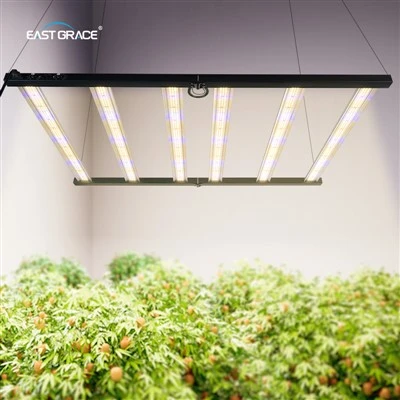
The advantage of multi-chip mixing is precise spectral control. Growers can tailor light recipes to different growth stages: higher blue ratios promote compact vegetative growth, while increased red and far-red enhance flowering and biomass accumulation. This approach also improves photosynthetic efficiency by targeting peaks in chlorophyll absorption and photomorphogenic responses.
Another benefit is dynamic tunability. With independent channel control, lighting systems can simulate sunrise/sunset, adjust daily light integral (DLI), and optimize crop-specific spectra in real time. However, achieving uniform spectral blending requires careful optical design, including lens selection and chip placement, to avoid color separation and ensure even canopy coverage.
Thermal management and driver complexity are also critical, as multiple high-power chips generate more heat and require stable current control. When properly engineered, multi-chip mixing delivers highly customizable, high-performance full-spectrum lighting for advanced horticulture applications.