


Description
Send Inquiry
UFO LED Grow Light Bulb C
Product Introduction
| The indoor growing market has spent the last decade chasing higher wattage, larger fixtures, and more complex control systems. But walk through the average home grower's setup and you will find a different reality: a clamp lamp clipped to a shelf, a desk fixture over a propagation tray, a pendant cord hanging in a small tent, or a floor lamp keeping a mother plant alive through winter. These growers do not need a commercial high-bay fixture-they need a light source that fits the fixtures they already own, delivers a spectrum the plants can actually use, and does not require a dedicated circuit or a ceiling mount. The UFO LED Grow Light Bulb C is built for that reality. It is a screw-in horticulture bulb with a standard E26/E27 base, a 120° wide beam angle, and a compact UFO form factor. It fits into the same sockets as a household lamp, which means it fits into the same spaces as the plants themselves. There is no separate driver, no controller, no ceiling hook, and no electrical work. You screw it in, set a timer, and start growing. Available in 20W and 30W configurations, the bulb pairs 450nm blue and 660nm deep red as the standard spectrum, with optional 385nm UV-A and 730nm far-red channels available for customized light recipes. The PPE of approximately 2.1 µmol/J means the bulb delivers a useful amount of usable light per watt, and the IP44 rating provides splash resistance for humid propagation areas, misting routines, and the general humidity of a working grow space. |
Specification Sheet
| Product Name | UFO LED Grow Light Bulb C | |
| Model | EG-RUBLGC-20 | EG-RUBLGC-30 |
| Product Picture | 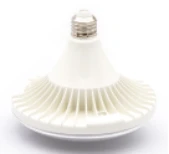 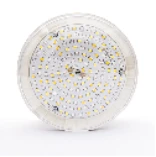 |
|
| Product Size(mm) | D130*H120 | D150*H140 |
| Wattage(W) | 20 | 30 |
| LED Qty | 144 | 240 |
| Spectrum | 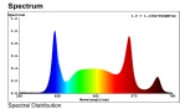 |
|
| LED Light Source | 450nm; 660nm; (385nm; 730nm) | |
| LED Brand | SANAN 2835 | |
| Product Materials | PC | |
| PPFD@0.3m(umols/s/m2) | ~100 | ~230 |
| PPE(umol/J) | ~2.1 | |
| Power Factor(PF) | >0.90 | |
| Flicker or Flicker Free | Flicker | |
| Input voltage(V)/ Frequency(Hz) |
AC200~240V 50/60Hz | |
| Dimming | Not Dimmable | |
| View Angle | 120º | |
| IP Rating | IP44 | |
| Color Rendering Index(Ra) | CRI>80 | |
| Operating Temperature(℃) | -15~40 | |
| Warranty | 3 Years | |
| Feature | 1. Customized Spectrum Available | |
Performance Comparison
| The screw-in grow bulb category is crowded with products that look similar on the shelf but diverge sharply in what they actually deliver to the canopy. The comparison below reflects the operational differences that matter to a grower deciding between options. | |||
| Performance Metric | UFO Bulb C (30W) | Typical Purple "Full Spectrum" Bulb | Typical Entry-Level Red-Blue Bulb |
| Rated Wattage | 30W | 20W (often overstated as "100W equivalent") | 15W (often overstated as "50W equivalent") |
| PPE | ~2.1 µmol/J | ~1.0–1.3 µmol/J (unverified) | ~0.8–1.2 µmol/J (unverified) |
| PPFD @ 0.3m | ~230 µmol/s/m² | ~60–90 µmol/s/m² | ~40–70 µmol/s/m² |
| Spectrum | 450nm + 660nm + optional 385nm/730nm | Blurred purple blend; often dominated by blue and low-efficiency red phosphor | Narrow red-blue blend with little blue balance |
| White-Light Appearance | Full-spectrum white with subtle warmth | Strong purple/magenta tint in living spaces | Harsh pink-purple tint |
| LED Package | SANAN 2835 (240 diodes) | Generic unbranded diodes | Generic unbranded diodes |
| Beam Angle | 120° | 90–120° (often uneven) | 60–90° (narrow hotspot) |
| Socket Base | E26/E27 standard | E26/E27 | E26/E27 |
| IP Rating | IP44 | None or unstated | None or unstated |
| Rated Lifespan | ~50,000 hours (LED source) | Unstated or 10,000–25,000 hours | Unstated |
| Warranty | 3 Years | None or 30–90 days | None or 30 days |
| Custom Spectrum Option | Yes (UV-A / Far-Red available) | No | No |
| The practical takeaway: many screw-in bulbs in this category are marketed with "equivalent wattage" numbers that do not translate to delivered PPFD. The UFO Bulb C publishes its actual wattage, actual PPE, and actual PPFD at a reference distance. For a grower comparing options, that transparency is the difference between designing a light plan and guessing. | |||
Core Technology & Engineering Design
| 1. Dense SANAN 2835 LED Array in a Compact UFO Housing The 30W model uses 240 SANAN 2835 LEDs arranged in a dense circular array behind a PC lens. The 20W model uses 144 LEDs. The LED count matters because it directly affects the uniformity of light distribution across the face of the bulb-a small number of high-power diodes creates a visible "spot" pattern, while a dense array produces a more even field. The UFO form factor distributes the LEDs symmetrically across the circular face, which is why the bulb produces a more uniform spread than a conventional bulb-shaped housing with a single cluster. SANAN 2835 package: A widely used horticulture LED package with stable wavelength binning. The 2835 form factor allows a high LED count in a compact area, which is why the bulb can pack 240 diodes into a 30W envelope. PC housing: Lightweight, impact-resistant, and electrically insulating. The PC housing also provides the structural base for the E26/E27 screw connection. Circular array geometry: The UFO shape is not cosmetic. It allows the LEDs to be arranged in concentric rings, which produces a more symmetrical light field than a linear or clustered arrangement. 2. Broad 120° Beam Angle for Small-Canopy Coverage The 120° beam angle spreads light broadly from the face of the bulb. In a screw-in format, this is a deliberate design choice: a narrow-beam bulb produces a concentrated hotspot directly under the fixture and darkness at the edges, which is useful for a single tall plant but poor for a tray of seedlings or a shelf of herbs. The 120° spread covers a wider area at a given mounting height, which is what most small-space growers actually need. Uniform coverage for trays and shelves: The wide spread reduces edge-to-edge PPFD variation in propagation trays and shelf sections. Overlap-friendly: In layouts with multiple bulbs, the wide beam allows overlapping coverage without creating intense hotspots where beams intersect. 3. Full-Cycle Baseline Spectrum with Optional Photomorphogenic Channels The standard spectrum combines 450nm deep blue and 660nm deep red-the two wavebands most directly tied to chlorophyll absorption and photosynthetic drive. 450nm deep blue: Regulates stomatal opening, drives chlorophyll synthesis, and supports compact vegetative structure. In a screw-in bulb, this is what keeps seedlings from stretching and herbs from becoming leggy. 660nm deep red: Sits at the peak of the photosynthetic action spectrum (McCree curve maximum) and drives biomass accumulation, flowering initiation, and fruit development. In a small-space setup, this is what supports the transition from vegetative growth to flowering and fruiting. The optional channels extend the bulb into more targeted applications: 385nm UV-A (optional): Associated with secondary metabolite and pigmentation pathways. Typically used as a controlled supplemental signal in late-stage or quality-focused applications, not as a primary photosynthetic driver. 730nm far-red (optional): Acts on phytochrome-mediated responses, including shade avoidance signaling and flowering transition timing. Relevant for growers who want to influence stretch, canopy architecture, or the timing of the flowering transition. Because the spectrum is customizable, the bulb can be specified to match the crop plan rather than forcing the crop to adapt to a fixed off-the-shelf spectrum. For commercial orders, custom spectrum tuning is available with MOQ. 4. IP44 Splash-Resistant Construction The IP44 rating provides protection against solid objects larger than 1mm and splashing water from any direction. In the context of a screw-in grow bulb, this is the relevant protection level: it covers the humidity of a propagation dome, occasional splashes during watering, and the general dampness of a working grow space. It does not claim to be immersible or hose-washable, and the product documentation is explicit about that boundary. Suitable for propagation areas: Misting, dome humidity, and routine watering are within the IP44 boundary. Not suitable for direct spray or immersion: The socket and bulb base should be kept clear of standing water, and the bulb should not be directly sprayed with a hose. 5. Screw-In E26/E27 Compatibility The E26/E27 base is the universal standard for household lighting in North America and Europe. This means the bulb fits into clamp lamps, desk lamps, floor lamp heads, pendant cords, and DIY canopy fixtures without an adapter. For growers who already have a lamp, they probably already have a grow light fixture-they just need the right bulb. No separate driver or controller: The bulb operates directly from the socket. There is no external driver to mount, no controller to program, and no wiring to modify. Timer-compatible: The bulb works with standard timer-equipped lamp holders or plug-in timers, allowing automated photoperiod control without additional hardware. |
Spectrum Guide
| The standard spectrum is a working full-cycle baseline, but growers running specific stages can use the optional channels to tilt the recipe. Here is how the spectrum choices map to actual growth phases. Seedlings and clones. Young plants need enough light to establish roots and build structure without stretching or stressing. The standard 450nm + 660nm spectrum at a moderate mounting height provides the blue component that encourages compact growth and the red component that supports energy capture. Keep the bulb at the higher end of the recommended height range and let the plants tell you if they want more intensity. Vegetative growth. During vegetative growth, the blue component does the heavy lifting: chlorophyll synthesis, stomatal regulation, and compact internode spacing. The UFO Bulb C's standard spectrum includes 450nm blue at a ratio that supports structural development without suppressing overall growth. For leafy greens and herbs where compactness and leaf density matter, the standard spectrum is appropriate as-is. Flowering and fruiting. When the plant transitions to flowering, the 660nm deep red component becomes the primary driver of photosynthetic energy capture and reproductive development. The standard spectrum already includes 660nm at a meaningful output. For growers who want to push flowering further, the optional 730nm far-red channel can be used to influence phytochrome-mediated responses including flowering transition timing and shade avoidance signaling. Quality-focused finishing. The optional 385nm UV-A channel is associated with secondary metabolite and pigmentation pathways. It is not a primary photosynthetic driver and should be used as a targeted supplemental signal rather than a full-cycle output. Growers working with aromatic herbs or crops where color and compound profile matter can specify this channel for late-stage use. |
Coverage, Mounting Height, and Layout Planning
| Because the bulb is a point source with a 120° beam angle, coverage and intensity are inversely related: higher mounting increases area but reduces PPFD at the canopy; lower mounting increases PPFD but reduces the illuminated area. |
| Industry sizing framework (starting point): | ||
| Application | Typical LED wattage per square foot of canopy | Implication for Bulb C |
| Seedlings / propagation | 15–20W/ft² | 20W bulb over a small tray or shelf section |
| Leafy greens / herbs (vegetative) | 20–30W/ft² | 20W–30W depending on canopy size and target compactness |
| Flowering / fruiting (supplemental) | 30–50W/ft² | 30W model or multiple bulbs to approach the target range |
| These are industry rule-of-thumb ranges, not guarantees of canopy PPFD. The actual PPFD at the leaf surface depends on mounting height, reflector (if any), and overlap between bulbs. For critical applications, measure PPFD with a quantum sensor at the canopy surface and adjust height or bulb count accordingly. | ||
| Recommended mounting height (starting point): | ||
| Stage / Application | Starting Height Above Canopy | Adjustment Direction |
| Propagation / seedlings | 35–45 cm | Lower slightly if stretching; raise if leaf stress |
| Vegetative growth | 30–40 cm | Lower for compactness; raise if bleaching |
| Flowering / fruiting (supplemental) | 25–35 cm | Lower for higher PPFD; monitor for heat stress |
| Bulb count starting points by space: | ||
| Space | Vegetative | Flowering / Fruiting |
| Propagation tray (standard 10×20 inch) | 1× 20W | - |
| Shelf section (60 cm) | 1× 20W | 1× 30W |
| Small grow tent (≤60×60 cm) | 1× 30W or 2× 20W | 2× 30W (if canopy allows) |
| Medium grow tent (60×60 to 90×90 cm) | 2× 30W | 3–4× 30W |
| Houseplant supplemental (single plant) | 1× 20W | - |
| These are starting configurations for layout planning, not fixed prescriptions. Final bulb count and height should be set from the measured PPFD at the canopy surface and the crop's stage-specific target. | ||
Application Scenarios
| Propagation stations and seedling shelves. The blue-forward standard spectrum supports strong establishment, and the compact form factor allows the bulb to sit close to trays and domes. The IP44 rating handles the humidity of misting and domes without the risk of an unrated household bulb. Kitchen herb gardens and microgreen trays. A clamp lamp with a UFO Bulb C is a practical way to keep herbs productive through winter or to run a small microgreen cycle on a countertop. The full-spectrum white appearance looks like a bright lamp rather than a purple grow-room fixture, which matters in a living space. Small grow tents and closet setups. For a 60×60 cm or 80×80 cm tent used for propagation or a small vegetative cycle, one or two bulbs can provide useful supplemental light. For flowering in the same tent, the 30W model or multiple bulbs will be needed to approach the PPFD range that fruiting crops expect. Supplemental lighting for houseplants and overwintering. Many tropical houseplants slow down in winter not because of temperature but because of reduced light. A screw-in grow bulb in a floor lamp or pendant can extend the useful photoperiod without a permanent installation. Educational and trial setups. The compact format and customizable spectrum make the bulb useful for classroom experiments or small comparative trials where a repeatable point source is needed. Retrofit and upgrade projects. For growers who already have clamp lamps or pendant fixtures but are using inefficient or incorrect-spectrum bulbs, the UFO Bulb C is a direct drop-in replacement that upgrades the light recipe without changing the fixture. |
Total Cost of Ownership
| The purchase price of a screw-in bulb is only one line item in the cost of running a grow space. The comparison below illustrates the operational logic over a 3-year period, using a representative small grow tent with 16 hours daily operation and $0.12/kWh electricity. | ||
| Cost Category | Typical 15W Entry-Level Bulb | UFO Bulb C (30W) |
| Upfront Cost per Bulb | $15–$25 | $35–$50 |
| Delivered PPFD @ 0.3m | ~40–70 µmol/s/m² | ~230 µmol/s/m² |
| Bulbs Needed for Equivalent PPFD | 3–5 bulbs | 1 bulb |
| Total Upfront for Equivalent Output | $45–$125 | $35–$50 |
| Annual Energy Cost (equivalent output) | Higher (more bulbs, more sockets) | Lower (fewer bulbs, fewer sockets) |
| Replacement Cycle | 10,000–25,000 hours (unverified) | ~50,000 hours (LED source) |
| Warranty | None or 30–90 days | 3 years |
| Spectrum Flexibility | Fixed | Customizable (UV-A / Far-Red optional) |
| The operational takeaway: a lower-cost bulb with lower PPE often requires more bulbs and more sockets to reach the same PPFD, which erodes the upfront savings over time. The UFO Bulb C's higher PPE and higher per-bulb output reduce the number of fixtures needed for a given PPFD target, and the 3-year warranty covers the period during which a lower-cost bulb would likely need replacement. | ||
Installation, Safety & Maintenance Boundary
| Socket and fixture compatibility. The E26/E27 base fits standard household lamp sockets. Confirm the socket and fixture are in good condition and rated for the bulb wattage. Timer-equipped lamp holders are available in regional standards and allow automated photoperiod control without an external timer. Thermal management. The bulb generates heat during operation. Do not enclose it in a sealed decorative shade with no airflow. In a clamp lamp or open pendant, passive convection is sufficient for the 20W and 30W power levels. In a closed grow tent, maintain normal ventilation and do not place the bulb in direct contact with plant tissue or flammable materials. IP44 boundary. IP44 provides protection against solid objects larger than 1mm and splashing water from any direction. It does not mean immersible, hose-washable, or suitable for direct spray. Keep the socket and bulb base clear of standing water. In propagation areas with misting, the bulb is appropriate; in areas with direct overhead irrigation that wets the fixture, it is not. Photoperiod control. The bulb operates with flicker and does not include a built-in timer. Use an external timer or timer-equipped lamp holder to manage light cycles. The bulb itself does not include a dimmer or controller. |
Quality Assurance & Warranty
| The bulb is manufactured under a controlled production process with incoming material inspection, automated assembly, aging tests, and photometric verification. The product carries a 3-year limited warranty covering defects in materials and workmanship. The warranty excludes damage from improper installation, overvoltage, water immersion, unauthorized modification, or operation outside rated environmental conditions. |
Frequently Asked Questions
| Q: Is this bulb a replacement for a commercial grow light fixture? A: No. It is a screw-in supplemental and small-space bulb. It is appropriate for propagation, herbs, microgreens, houseplants, and small tent setups. For high-PPFD flowering in larger spaces, a dedicated fixture is the correct tool. Q: Can I use it in a standard desk lamp or clamp lamp? A: Yes. The E26/E27 base fits standard household sockets. Confirm the fixture is in good condition and has adequate ventilation around the bulb. Q: What is the difference between the 20W and 30W models? A: The 30W model delivers approximately 2.3× the PPFD at the same reference distance (~230 vs. ~100 µmol/s/m² at 0.3m) and has a larger physical size. It is appropriate for larger canopies, flowering/fruiting supplemental lighting, or layouts where fewer bulbs are preferred. Q: Is the bulb dimmable? A: No. Output is fixed. Intensity is controlled by mounting height and bulb count. For dimmable options, please inquire about other product families. Q: Can I use it in a humid propagation area with misting? A: Yes. The IP44 rating provides splash resistance. Keep the socket and base clear of standing water and avoid direct hose spray on the fixture. Q: Do you offer custom spectrum? A: Yes. Optional 385nm UV-A and 730nm far-red channels are available, and custom spectrum is available for commercial orders (MOQ applies). Contact our technical team with your crop and target response requirements. Q: How many bulbs do I need for a 60×60 cm grow tent? A: For vegetative growth, 1×30W or 2×20W is a reasonable starting point. For flowering/fruiting, expect to use 2×30W if canopy space allows, and measure PPFD at the canopy to confirm the target is met. Q: What is the expected lifespan of the bulb? A: The LED source is rated for approximately 50,000 hours. At 16 hours per day, that is over 8.5 years of operation. The 3-year warranty covers defects in materials and workmanship during the early portion of that lifespan. |
Request a Quote
| For product quotations, spectrum customization requests, or bulk pricing, send us an inquiry with your required model, quantity, and application details. Our team will respond with a proposal and configuration recommendation within 24 business hours. |
Hot Tags: 20w 30w ufo led grow light bulb c, China 20w 30w ufo led grow light bulb c manufacturers, suppliers, factory, grow lights full spectrum bulbs, key greenhouse grow light, led grow light full spectrum, led grow light top lighting ceiling, led grow top light, top grow light


