


DALI (Digital Addressable Lighting Interface) represents a significant leap forward in dimming technology, offering a fully digital, bidirectional communication protocol standardised under IEC 62386. Unlike analog systems, DALI allows each luminaire to have a unique address, enabling independent control of every light fixture on the same two‑wire bus. Commands are transmitted digitally using a Manchester‑encoded signal at 1,200 baud, supporting up to 64 devices per DALI line (expandable via gateways). This digital architecture enables advanced functionalities such as individual dimming, group control, scene presets, color‑tuning (with DALI‑2 and D4i extensions), and real‑time status feedback – including lamp failures, driver errors, and power consumption data. The flexibility of DALI is particularly valuable in commercial and institutional settings where lighting needs to adapt dynamically. In a modern open‑plan office, for example, DALI‑controlled luminaires can be grouped by workstations, with daylight sensors adjusting output near windows while maintaining higher levels deeper inside. A single control panel can recall "presentation" mode (dimming the front rows, brightening the screen area) or "cleaning" mode (full brightness) at the touch of a button. Moreover, the bidirectional nature simplifies commissioning and maintenance: a facility manager can query the DALI bus to identify a faulty lamp without inspecting each fixture. The main downside is cost – DALI drivers and controllers are more expensive than their analog or PWM counterparts, and the system requires skilled programming. Nevertheless, for projects demanding fine‑grained control, energy reporting, and future‑proof integration with building management systems, DALI is the industry standard of choice.
In-Depth Analysis of Dimming Technologies: DALI Dimming (Digital Addressable Lighting Interface)
Popular Products
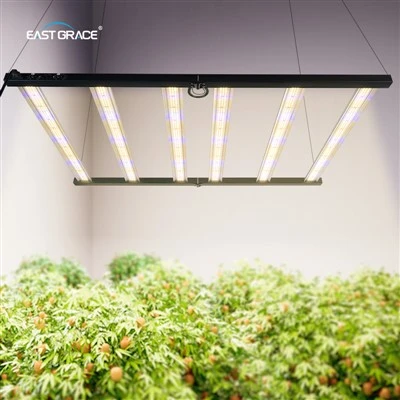
AluminumFoldable LED Grow Light Bar Module B
Features:1. 1600~2500 umol/s High PPFD@0.3m2. 2.4~2.7 μmol/j High Efficacy3. -15~40°C Operating Temperature4. Flicker

50/80W T102 Triproof Grow Light Bar
T102 Triproof Grow Light Bar Product Features & Benefits Slim Profile for Space-Constrained Installations The

T8 Waterproof Integrated LED Tube Grow Light A
LED Strip Structure:1. SMD2835 LED Chip2. Protective Layer3. Insulation Layer4. Copper Layer -1oz,20z5. Tape -3M

UFO LED High Bay Grow Light Fixture
EG-UHBGL-250 LED grow light has excellent lumen output, long-lasting stability, and brilliant vision. UFO LED high bay

DC Strip LED Grow Light
DC Strip LED Grow Light housing is made of high-quality aluminum with good heat dissipation, which is perfect for

T8 Integrated LED Tube Grow Light
The EG-I8PATG-150 LED Grow Light specializes in indoor plant growth. The grow lights combine the full spectrum of blue